Case study · Product management exercise
Duolingo Goal Path: let a learner's goal pick the situations they practice
- Project type
- Product management exercise (A/PM take-home, Duolingo)
- Status
- Submitted as a take-home; not built or shipped.
- Role
- Solo. I did the user interviews, review analysis, problem choice, feature definition, screen mockups, KPI choice, and the validation and A/B plan.
- Result
- Submitted as a 5-slide take-home. Not shipped, no measured results. Slide 5 is the plan to test it.
In the downloadable deck, interviewee usernames are replaced with Interviewee A to E.
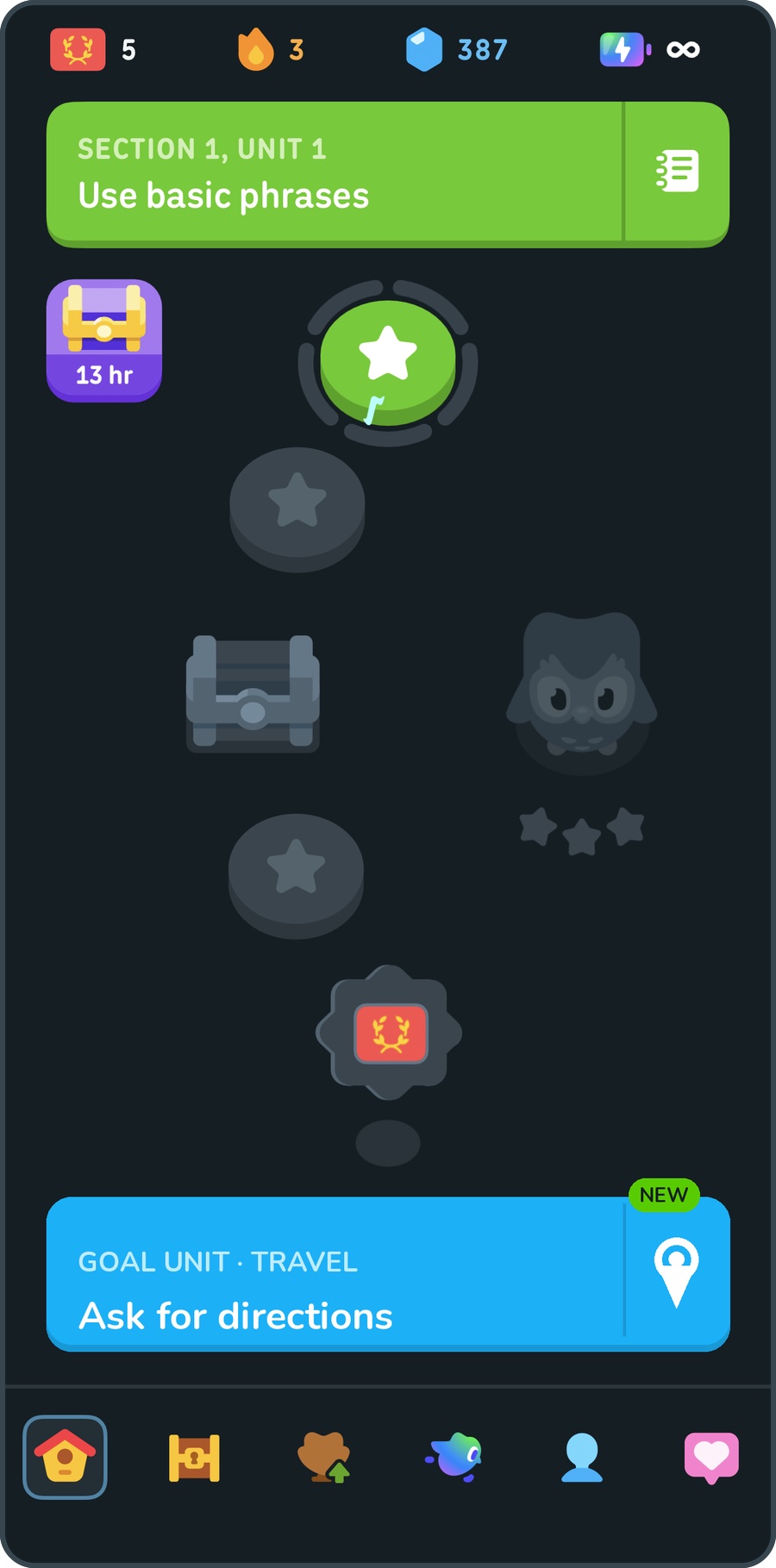
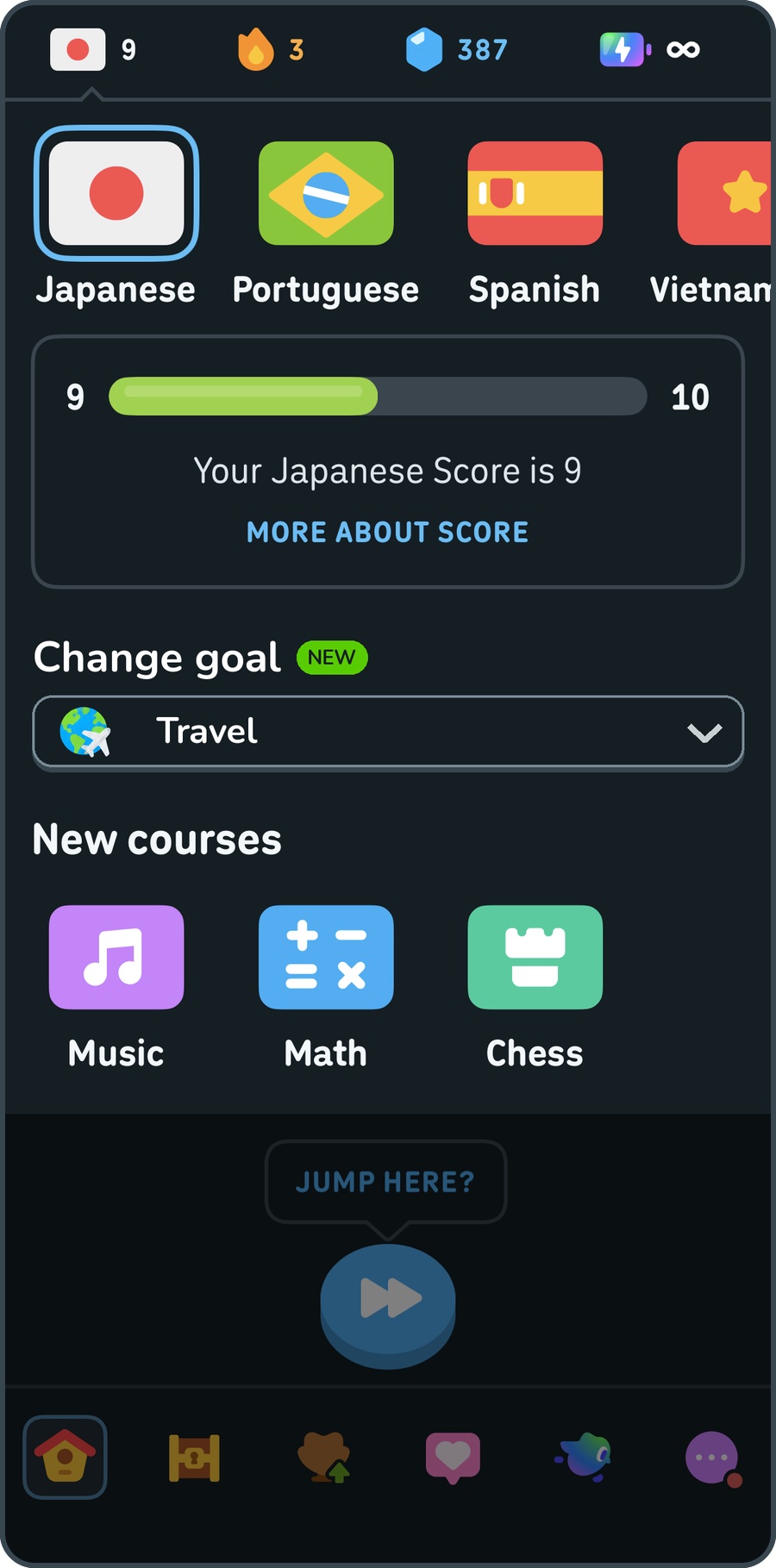
Your goal picks the situations you learn.
What's real vs. what's planned
| Part | Status |
|---|---|
| Interviews | Done 5 |
| Review analysis | Done 500 reviews |
| Competitive scan | Not done |
| Validation and outcomes | Planned not done |
1A real problem
The user is the Duolingo learner with a goal (travel, media, work, family), not "language learners" in general. Their pain point: lessons are generalized and don't match why they're learning.
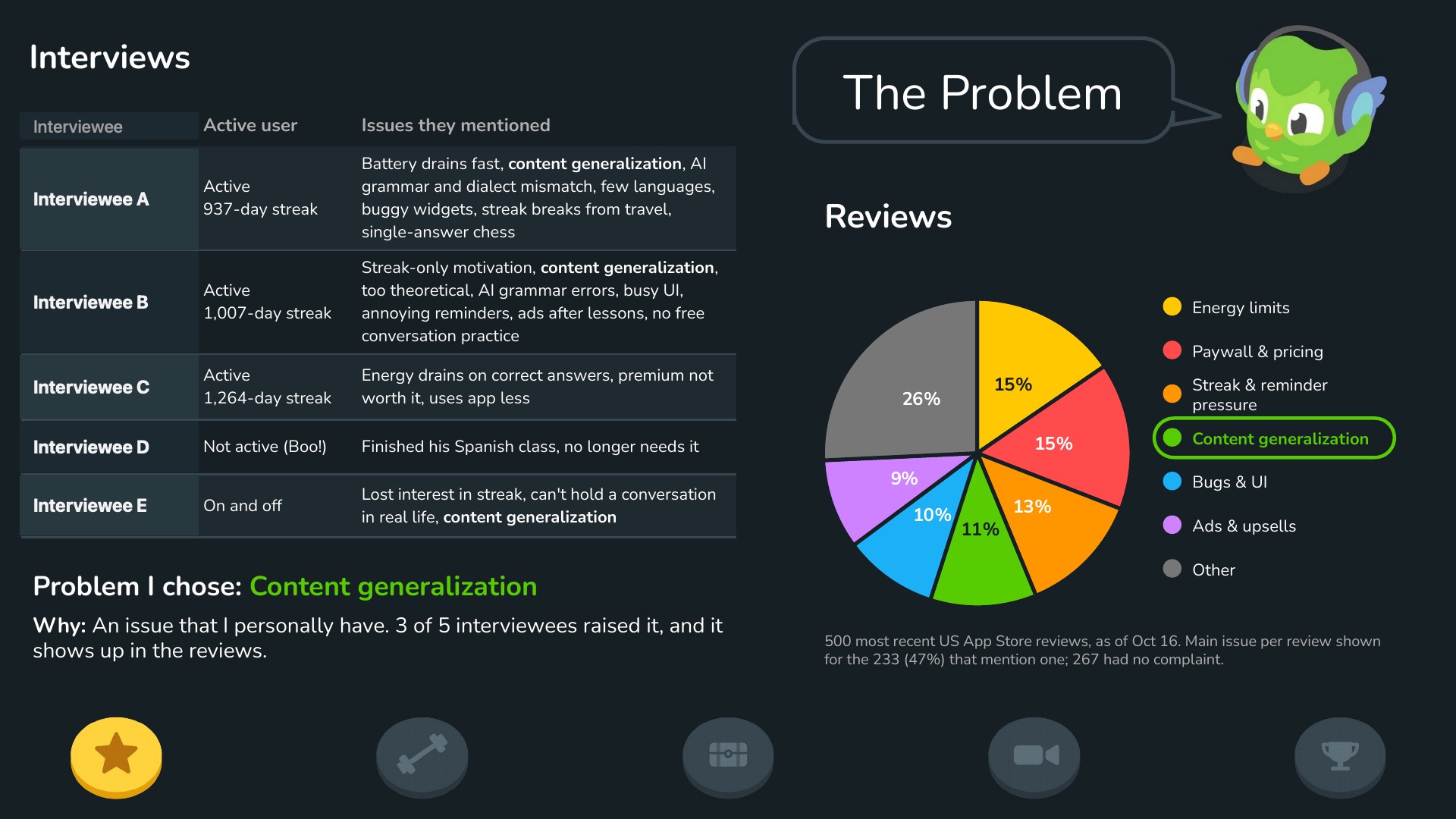
The problem I chose was content generalization. Why: it's an issue I have personally, 3 of 5 interviewees raised it, and it shows up in the reviews.
Evidence
- 5 interviews (see Original research).
- The 500 most recent US App Store reviews as of Oct 16: 233 (47%) mention an issue and 267 have no complaint. Of those that mention one: Energy limits 15%, Paywall & pricing 15%, Streak & reminder pressure 13%, Content generalization 11%, Bugs & UI 10%, Ads & upsells 9%, and Other 26%.
- Two interviewees with 1,000+ day streaks open the app mainly to keep the streak. One said why: the lessons aren't usable in real life.
Why it matters
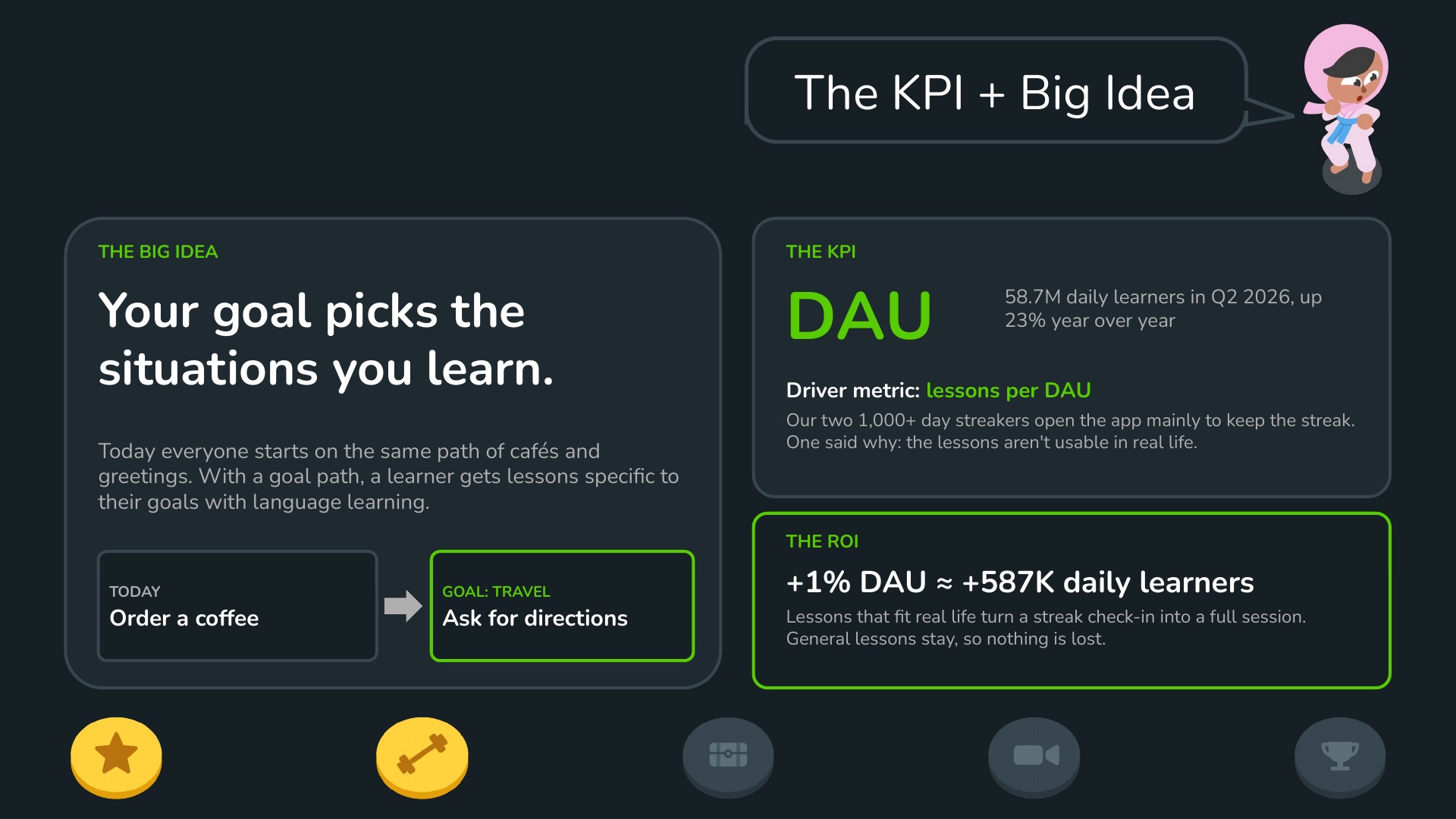
Duolingo had 58.7M daily active users in Q2 2026, up 23% year over year (Q2 FY26 filing ). As an illustration of scale, not a forecast: +1% DAU is about +587K daily learners.
The problem I chose: content generalization, because lessons don't match why someone is learning.
2Original research
5 interviews
| Interviewee | Status | Streak | Issues raised |
|---|---|---|---|
| Interviewee A | Active | 937 days | Battery drains fast, Content generalization, AI grammar and dialect mismatch, Few languages, Buggy widgets, Streak breaks from travel, Single-answer chess |
| Interviewee B | Active | 1,007 days | Streak-only motivation, Content generalization, Too theoretical, AI grammar errors, Busy UI, Annoying reminders, Ads after lessons, No free conversation practice |
| Interviewee C | Active | 1,264 days | Energy drains on correct answers, Premium not worth it, Uses app less |
| Interviewee D | Not active | - | Finished his Spanish class, no longer needs it |
| Interviewee E | On and off | - | Lost interest in streak, Can't hold a conversation in real life, Content generalization |
3 of 5 raised content generalization. 3 were active users with 900 to 1,264 day streaks; 1 was not active (finished his Spanish class, no longer needs it); 1 uses it on and off (lost interest in the streak, can't hold a conversation in real life).
500 App Store reviews
Main issue in the 233 reviews that mention one.
Show as a table
| Main issue | Reviews | Share of 233 |
|---|---|---|
| Energy limits | 36 | 15% |
| Paywall & pricing | 36 | 15% |
| Streak & reminder pressure | 30 | 13% |
| Content generalization | 26 | 11% |
| Bugs & UI | 23 | 10% |
| Ads & upsells | 22 | 9% |
| Other | 60 | 26% |
Issue tags are my own judgment, one issue per review, so counts are approximate.
A limit of this evidence: the 11% content slice is broader than "too generic." In my own stricter read, only 8 of the 26 (about 3% of the 233) explicitly call the content too generic or irrelevant. The rest are about grammar explanations, repetition, or floods of new words after course updates.
Competitive scan
Not done I did not do a formal competitive scan for this exercise. That's a gap I would close first.
Small and informal: 5 interviews and 500 hand-tagged reviews, with no competitive scan.
3Scope and decisions
Problem statement: lessons are general, so learners can't use them in real life. Goal Path lets learners pick a goal and see lessons built around it.
Success metric: DAU is the headline (58.7M, Q2 2026). The driver metric is lessons per DAU. The deck links lessons per DAU to DAU, but that link isn't proven in the deck (see the reflection).
What comes first (the proposal): one course, Travel only, 3 Goal Units built from existing exercise types. Everything else is cut for now: other goals (Media, Work, Family) beyond picking them, and new exercise types. Why that cut: it's scoped for an intern project (about 12 weeks).
Design decisions
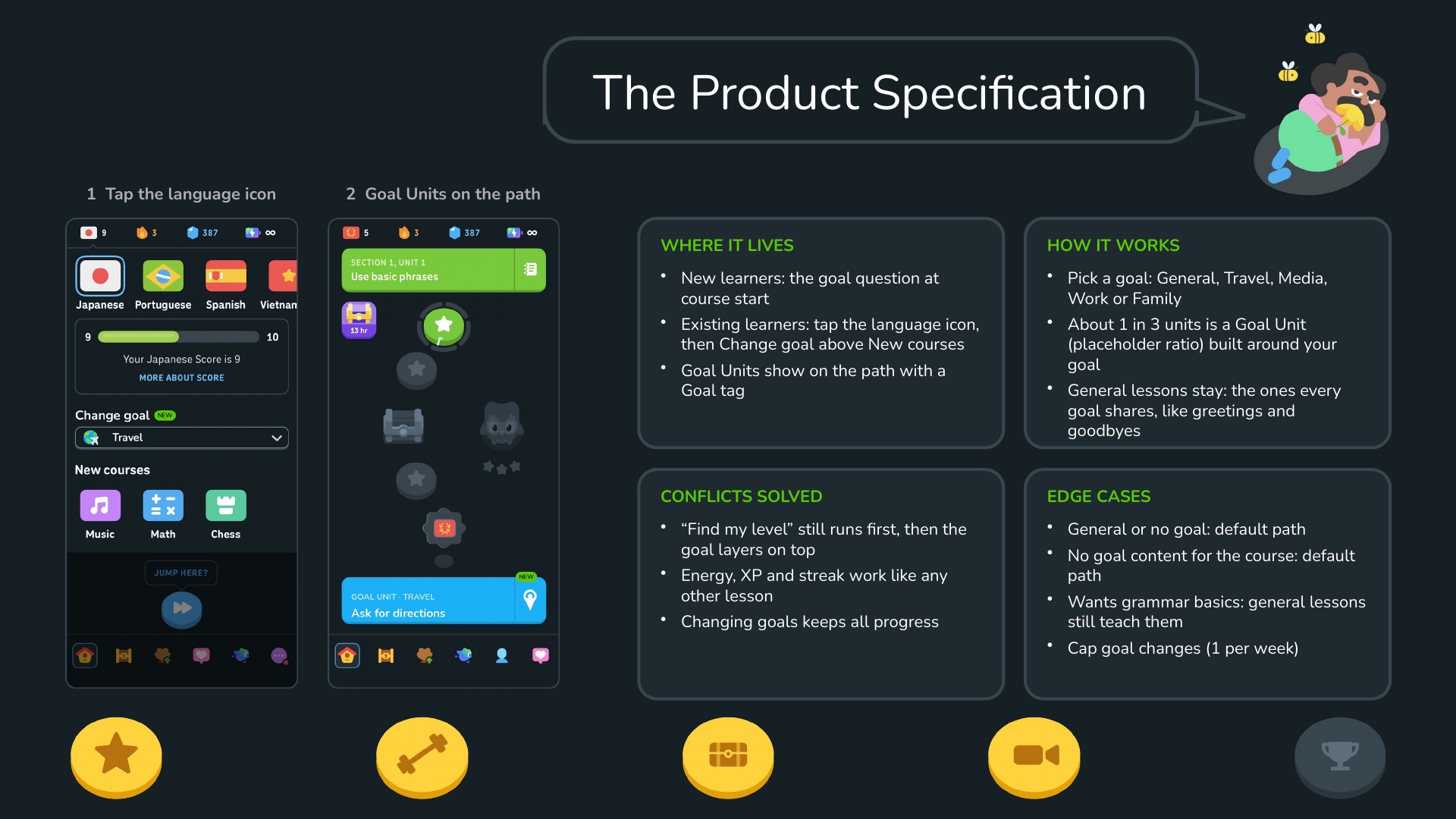
- New learners get the goal question at course start. Existing learners tap the language icon, then "Change goal" above "New courses."
- Goals: General, Travel, Media, Work, Family.
- Goal Units appear on the path with a "Goal" tag. About 1 in 3 units is a Goal Unit (a placeholder ratio, not tested).
- General lessons stay: the ones every goal shares, like greetings and goodbyes. Nothing is lost.
- "Find my level" still runs first; the goal layers on top.
- Energy, XP and streak work like any lesson. Changing goals keeps all progress.
- Edge cases: General or no goal gives the default path; a course with no goal content gives the default path; learners who want grammar basics still get them through the general lessons; goal changes are capped at 1 per week.
Constraints: 5 interviews, one person's judgment on review tagging, no access to Duolingo's internal data, and a take-home with no build.
The minimal version: one course, Travel only, 3 Goal Units built from existing exercise types.
4Process
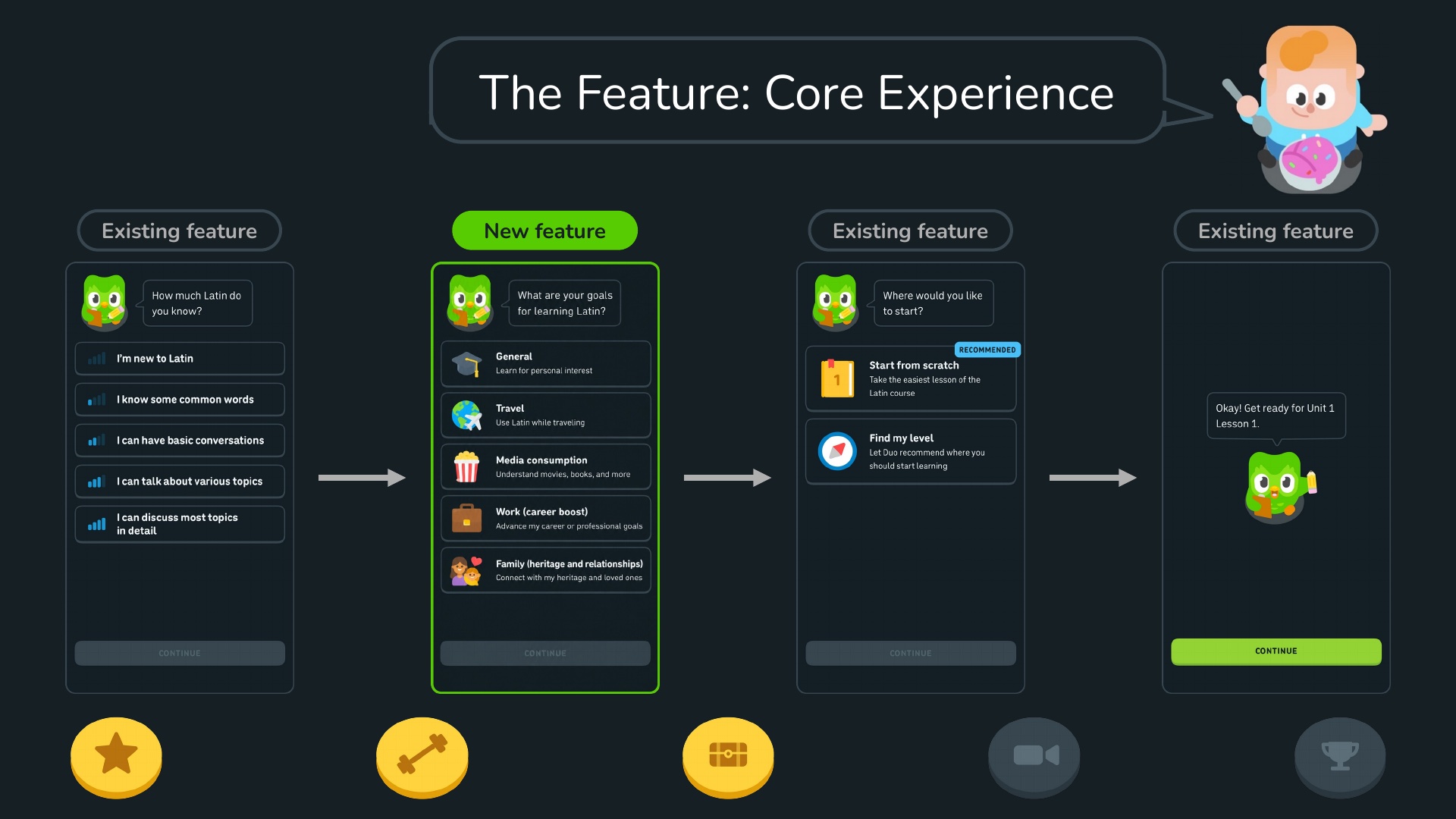
The goals screen is added to onboarding; existing learners get a "Change goal" dropdown; Goal Units then appear on the path.
- Existing feature
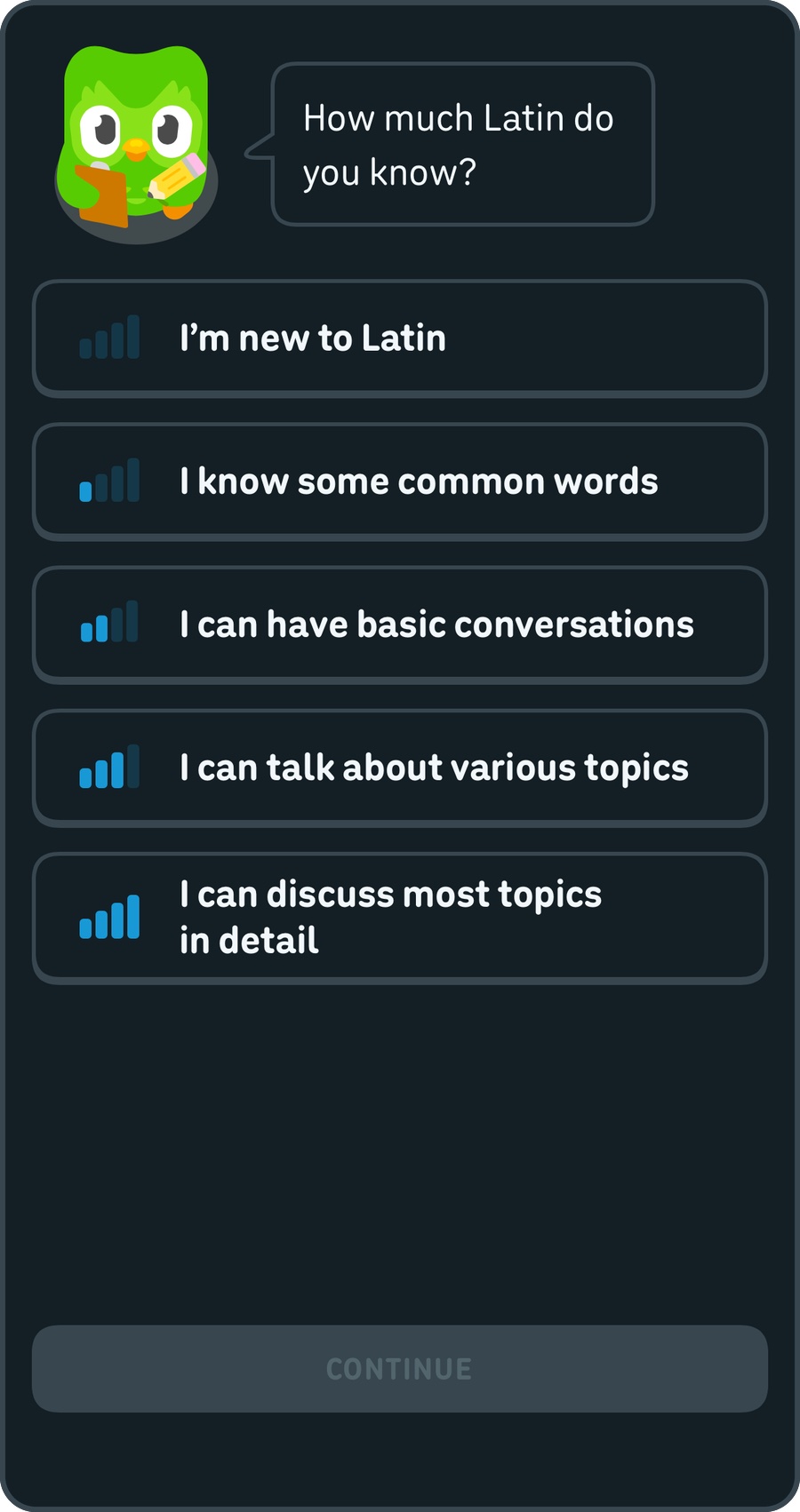 "How much Latin do you know?"
- New feature
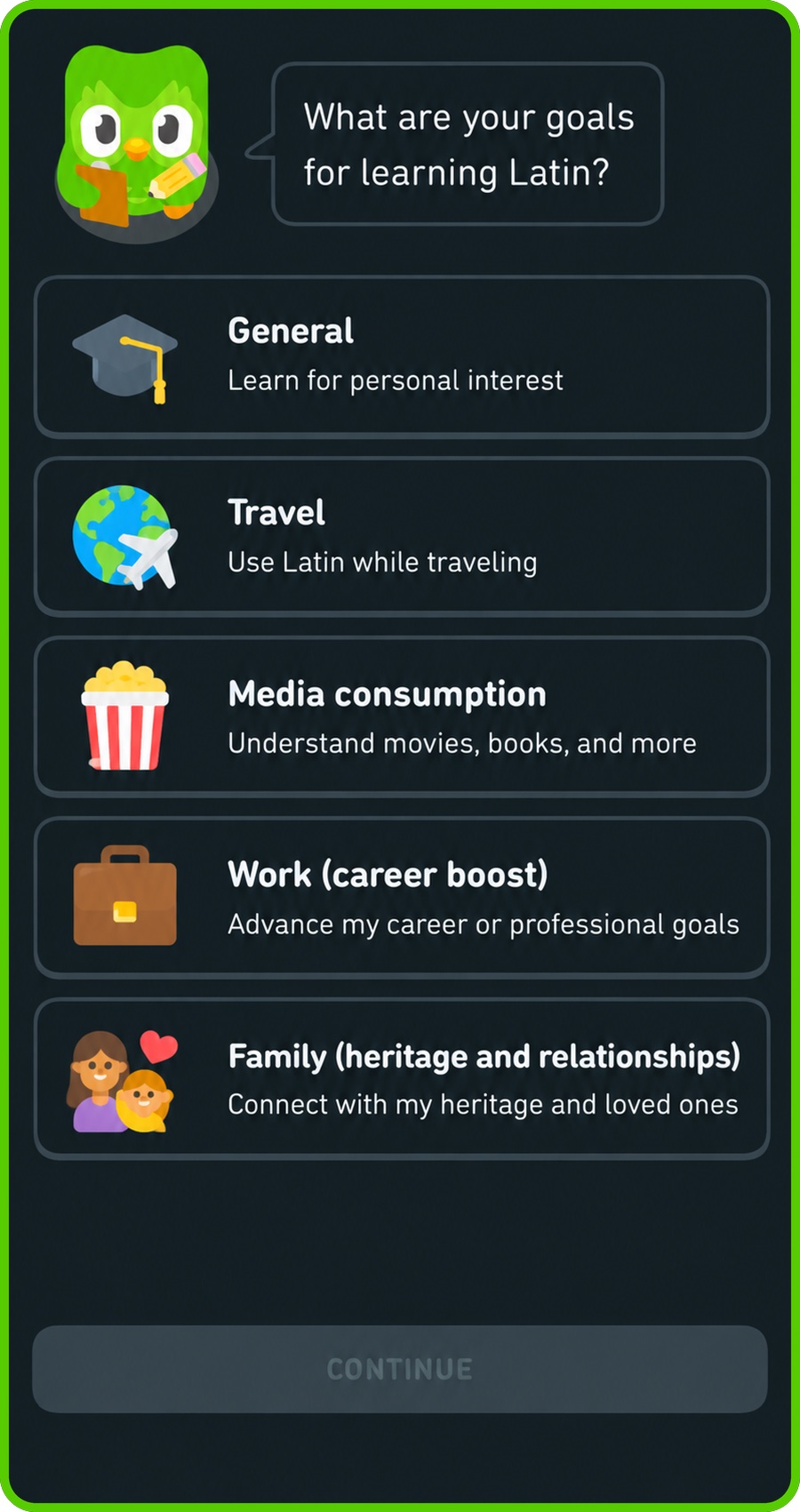 "What are your goals for learning Latin?" My new goals screen.
- Existing feature
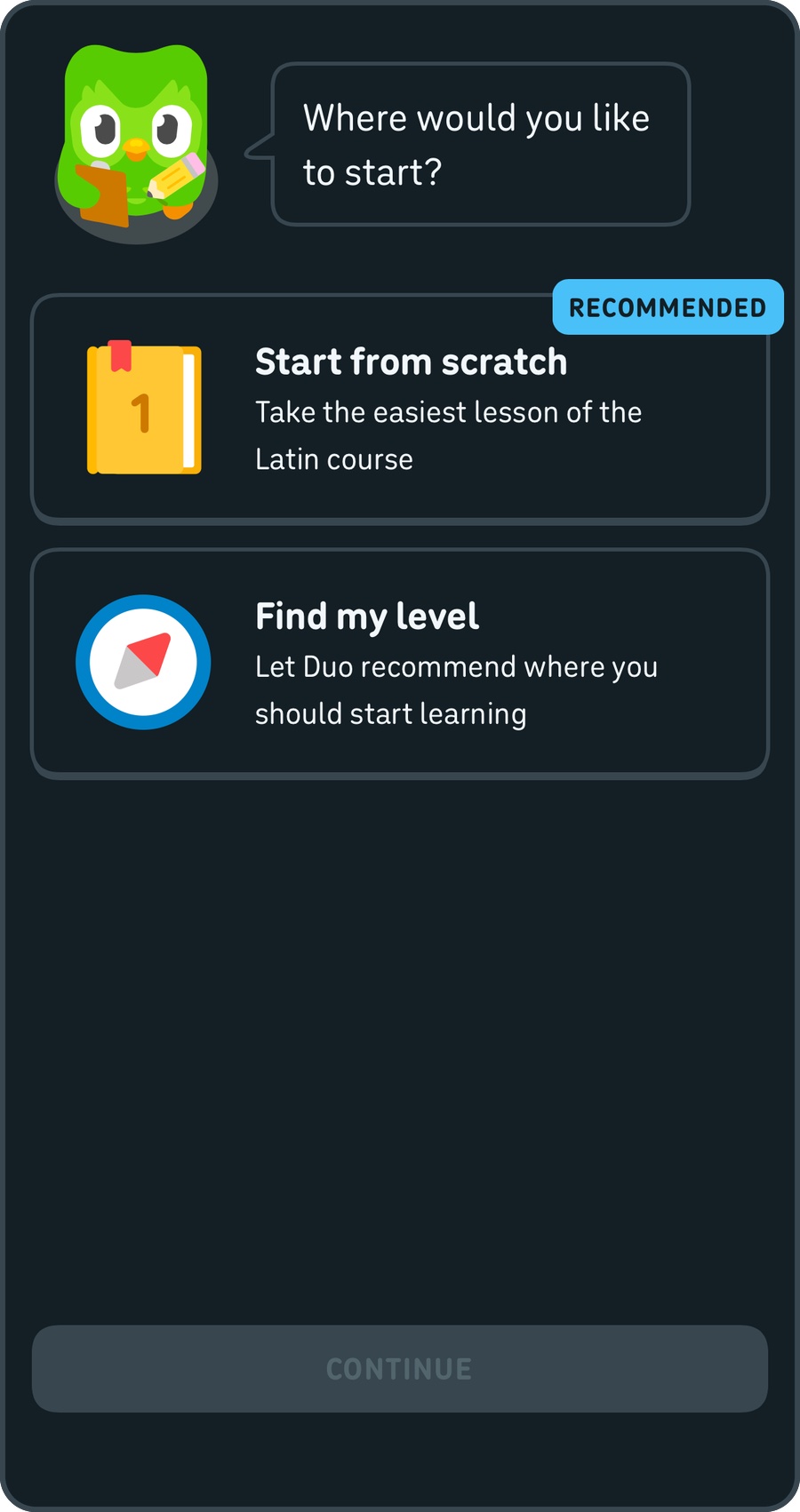 "Where would you like to start?"
- Existing feature
 "Okay! Get ready for Unit 1."
Not shown I didn't document early sketches or rejected alternatives for this exercise.
The submitted deck
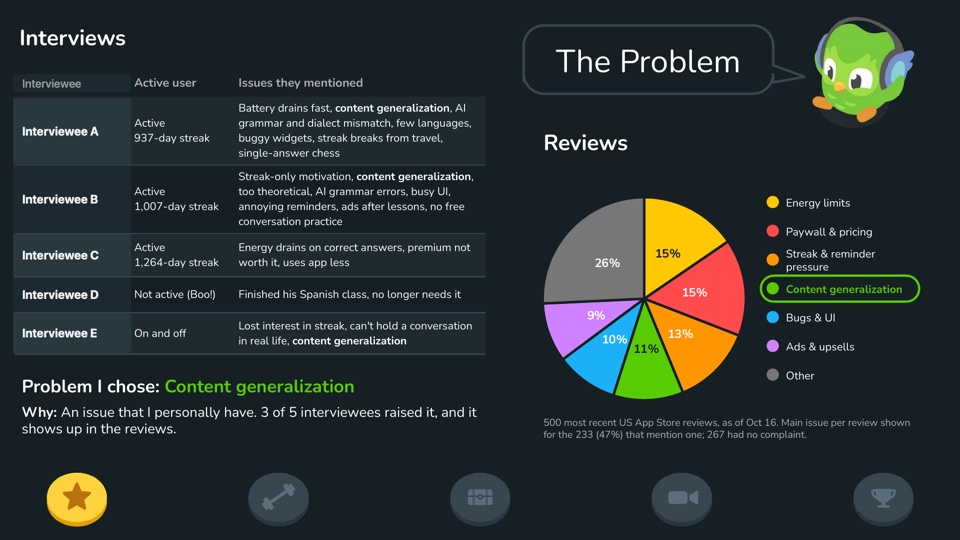 Slide 1. The problem: the five interviews and the review breakdown.
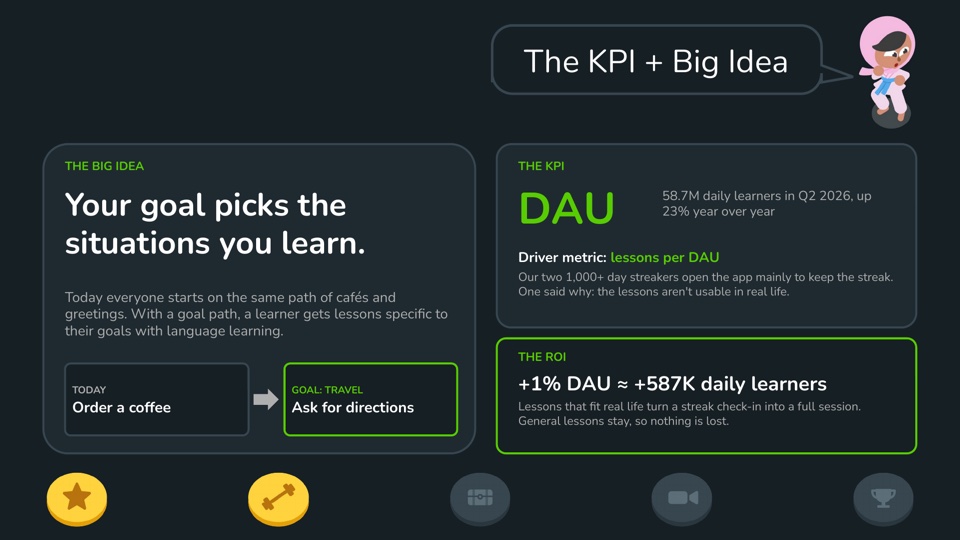 Slide 2. The KPI and the big idea: DAU, lessons per DAU, and "Your goal picks the situations you learn."
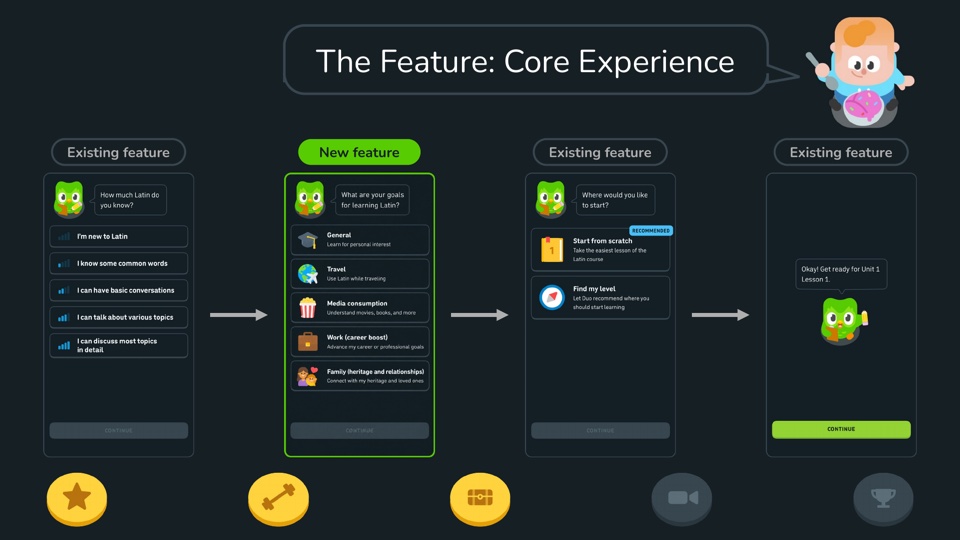 Slide 3. The feature: the new goals screen inside the existing onboarding flow.
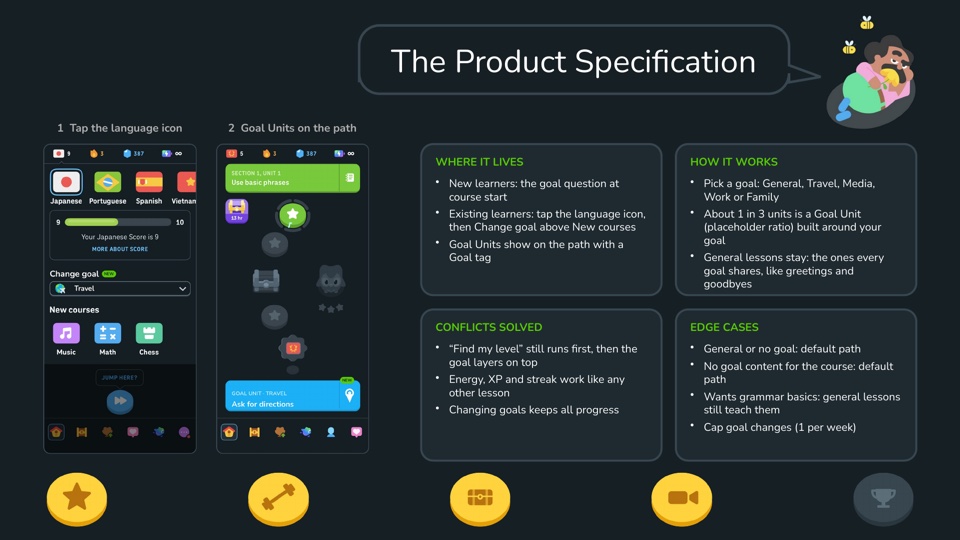 Slide 4. The product specification: where it lives, how it works, conflicts solved and edge cases.
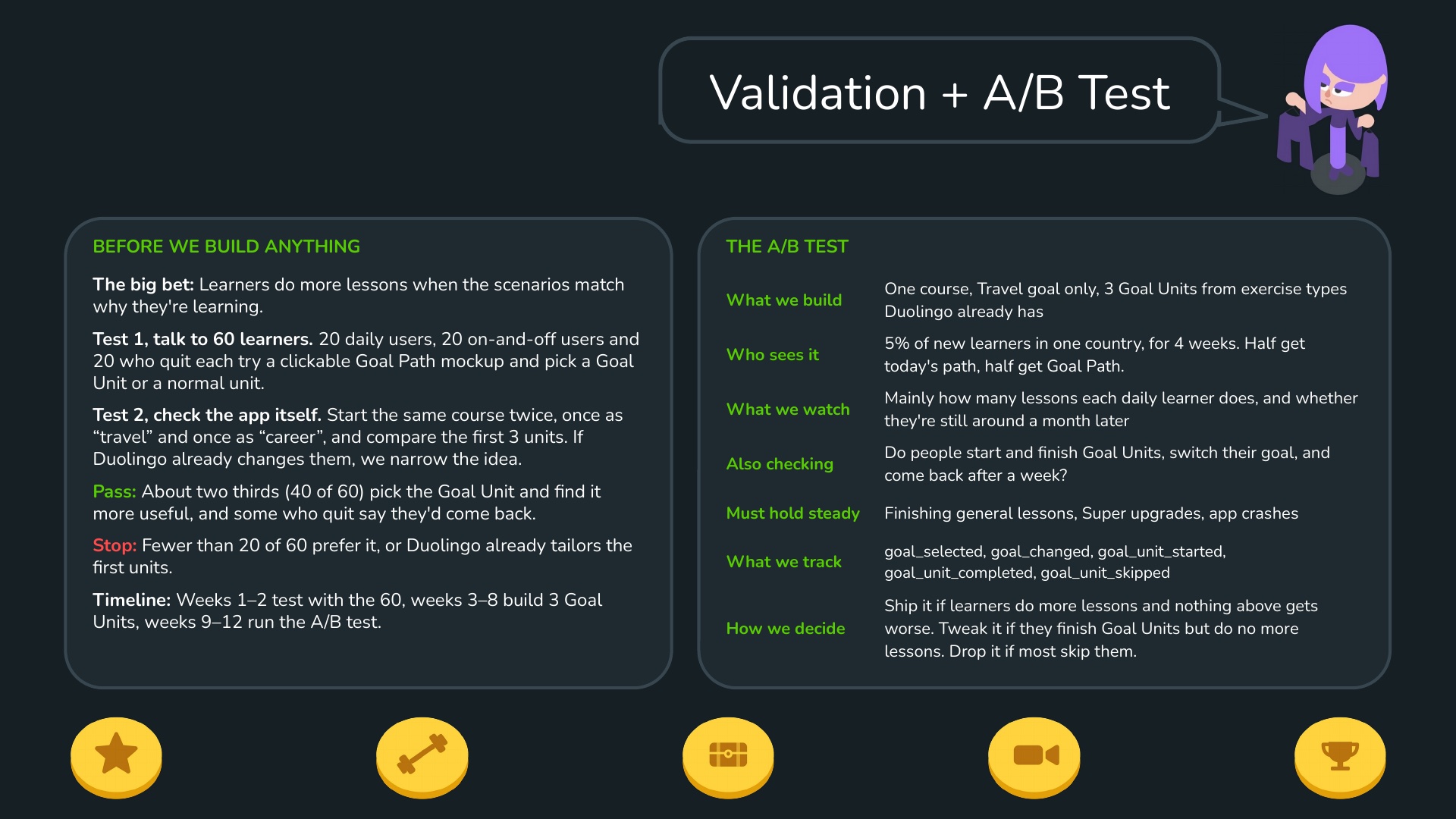
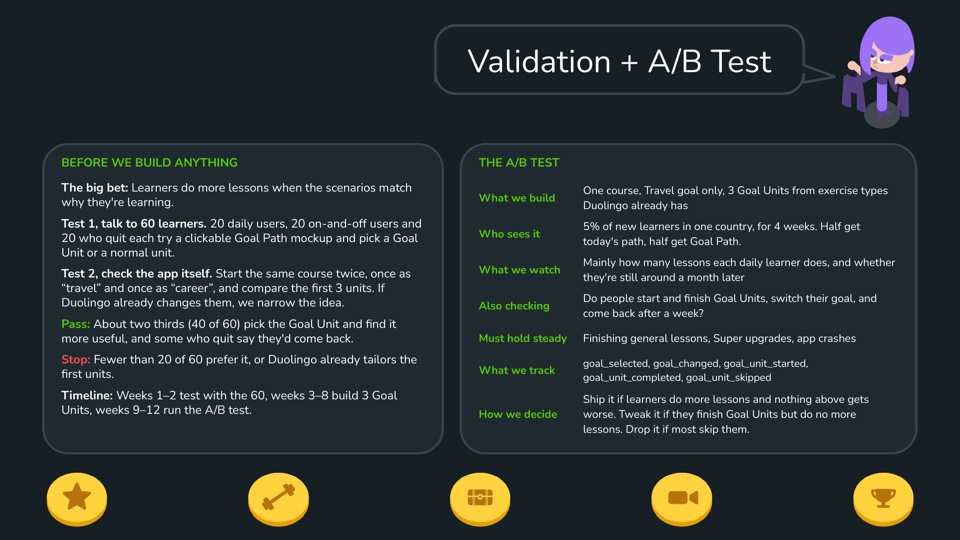 Slide 5. Validation and the A/B test plan, with pass and stop criteria.
One real tradeoff: keep general lessons alongside goal lessons instead of replacing them.
5Validation
Not done I have not tested this with real people. What exists is the validation plan from slide 5.
- Big bet Planned
- Learners do more lessons when scenarios match why they're learning.
- Test 1 Planned
- Talk to 60 learners (20 daily, 20 on-and-off, 20 who quit) with a clickable Goal Path mockup.
- Test 2 Planned
- Check the app itself: set up the same course with a "travel" goal and a "career" goal and compare the first 3 units, to see whether Duolingo already tailors early units.
- Pass Planned
- About two thirds (40 of 60) pick the Goal Unit and find it more useful, and some who quit say they'd come back.
- Stop Planned
- Fewer than 20 of 60 prefer it, or Duolingo already tailors the first units.
- Timeline Planned
- Intern scale: weeks 1 to 2 test, weeks 3 to 8 build 3 Goal Units, weeks 9 to 12 run the A/B test.
Pass and stop criteria are set before anything gets built.
6Outcomes
No outcomes. Nothing was shipped or tested. Below is the planned measurement from slide 5.
- A/B test Planned
- One course, Travel only, 3 Goal Units. 5% of new learners in one country for 4 weeks; half get today's path, half get Goal Path.
- Primary Planned
- Lessons per daily learner, and whether they're still around a month later.
- Also watching Planned
- Goal Unit starts and finishes, goal switches, and coming back after a week.
- Must hold steady Planned
- Finishing general lessons, Super upgrades, app crashes.
- Tracking events Planned
goal_selected,goal_changed,goal_unit_started,goal_unit_completed,goal_unit_skipped- Decision rule Planned
- Ship it if learners do more lessons and nothing above gets worse. Tweak it if they finish Goal Units but do no more lessons. Drop it if most skip them.
The real outcome: the deck itself, submitted.
The only real outcome is the submitted deck.
7Role and reflection
Role: solo. I owned the interviews, review analysis, problem choice, feature definition, mockups, metric choice and test plan. There was no build or launch.
What I'd do differently
- The DAU link. The deck picks DAU with lessons per DAU as the driver, but the slides never show why more lessons per user would raise DAU. I would add that mechanism, or pick a metric the feature more directly moves.
- Preference vs. behavior. The pass bar in Test 1 counts learners who say they prefer the Goal Unit. What they say and what they do can differ, so the A/B test is the real check.
- New learners vs. veterans. The A/B test targets new learners, but most of my evidence comes from long-streak users. Those are different groups.
- Evidence breadth. The 11% content slice is broader than strict "too generic" complaints (about 3% by my stricter read).
- Sample size. Five interviews and one reviewer's tagging is thin. I would add more interviews and a second person to tag reviews.
- Competitive scan and early sketches. Do these first next time.
- Existing tailoring risk. Duolingo's "why are you learning" onboarding may already tailor early lessons. Test 2 exists to check it, and I'd run that first.
What I learned
- Scoping to an intern-sized project.
- Defining pass and stop criteria before building.
- Being clear about what the evidence does and doesn't support.
Scope small, set pass and stop criteria first, and be clear about what the evidence does and doesn't support.
Independent exercise. Not affiliated with, endorsed by, or built for Duolingo. Duolingo and related marks belong to Duolingo, Inc. Screens marked "new" are my own mockups.